Sleep…
One of life’s great mysteries.
How much is enough? How does one achieve a night of uninterrupted, REM-stage sleep so even the most basic tasks can be done and peak or near-optimum levels day in and day out?
Sadly, 7 in 10 Americans lack the recommended 7-to-9 hours of restorative sleep needed each night, leading to a multi-billion dollar juggling act to find a solution.
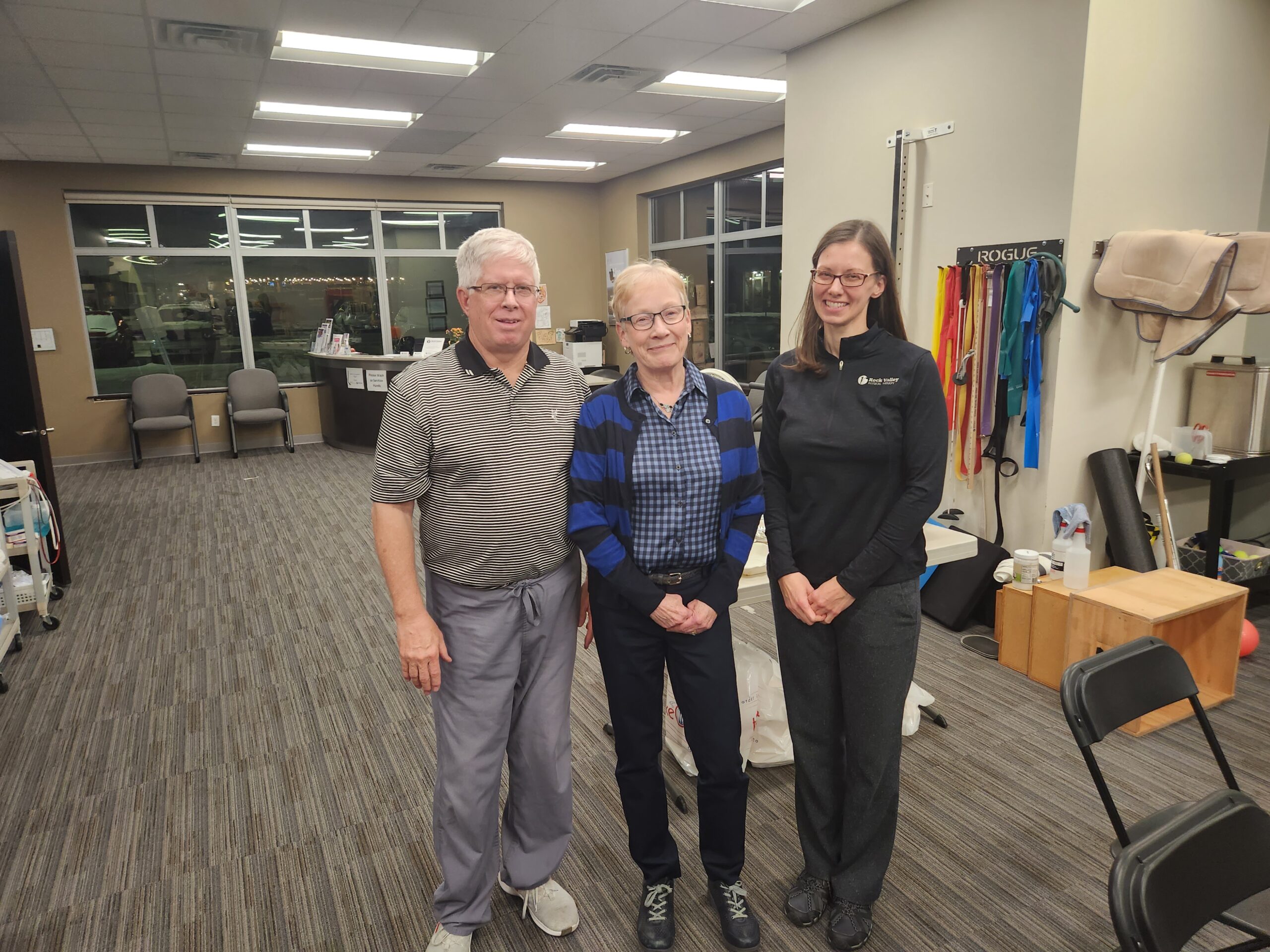
On a snowy, icy evening inside a gorgeous Rock Valley Physical Therapy clinic on the edge of North Liberty, Iowa, a trio of medical experts gave their time and energy to lend insight to the mysteries – and solutions – to a better night’s sleep.
The event, coordinated by Brittney Davis, PT, DPT, clinic manager at Rock Valley’s North Liberty campus, featured Rock Valley Physical Therapy’s Cathy Herman, PT, DPT; Maureen Connolly, MD, Remedy Internal Medicine; and Dr. Terrance Riley, DDS.
The trio shared a mutual appreciation for each other’s profession and the work and effort that goes into educating – and treating – the public in hopes of attaining a restful night’s sleep.
Herman shared insight to better sleep through (body) positioning, exercise and breathing, noting that half of our lives is spent sleeping. Connolly shared tips for better sleep hygiene, while Riley lent insight into the work the dental profession has had in sleep-aids, its work on snoring and sleep apnea, and that sleep appliances have a rightful place for better sleep.
EXERCISE
Herman also lectured on the importance of exercise in relation to sleep, noting that optimizing one’s exercise routine – whether it be aerobic and strength – can potentially help you sleep better. And that an adequate amount of sleep is likely to promote healthier physical activity levels during the day.
BREATHING
Those gathered took notice when Herman talked breathing, telling the crowd that relaxation before bed is an important part of good sleep hygiene. Herman, who earned her undergraduate degree in Biology from the University of Northern Iowa and received her Doctor of Physical Therapy degree from the University of Iowa, said breathing simply calms you by acting on components of your nervous system.
Herman offered an example of a simple deep-breathing exercise to enhance one’s chances of finding sleep.
She recommended placing both hands over your navel and working a set of deep breaths through the nose and out of the mouth.
She suggested:
- Breathe in through your nose on a count of four, trying to do so consciously with your abdomen expanding instead of your rib cage. One should feel their abdomen going up as you breathe in.
- Exhale through your nose on a count of six. The longer exhalation is key to deep breathing’s calming effect.
- Slow, deep-breathing serves to combat residual stress or anxiety, and deep-breathing can redirect your mind from daily worries.
POSTURE:
Good posture is beneficial to better sleep.
Herman offered that the best sleep position is one that promotes healthy spinal alignment from the hips to the head, and that a neutral spine is ideal. What that looks like depends on one’s personal health situation – injury, etc. – and what one finds comfortable.
Herman also shared that some positions are considered healthier than others. Specifically, sleeping on the side or back is considered more beneficial than sleeping on the stomach. In those particular sleep positions, it’s easier to keep the spine supported and balanced, which relieves pressure on the spinal tissues and enables one’s muscles to relax and recover.
SLEEP HYGIENE:
Dr. Connolly addressed good sleep hygiene, a set of regular behaviors or habits that can encourage improved sleep. Several simple, straightforward tips can be incorporated into a nightly routine.
They are:
- Optimize the bedroom for sleep. It’s important to have the right surroundings to encourage good sleep. A quiet, cool and dark room, works best.
- Have a consistent bedtime and wake-up time. Going to bed and waking up at the same time every day is a great way to establish a healthy routine and can help one sleep better. It is important to follow the same schedule on weekends and while you’re on vacation for it to be effective.
- Prioritize getting enough sleep. A minimum of 7 to 8 hours is the optimum number.
- Cut back on alcohol and caffeine before bed, though a cocktail with a meal early in the evening, is a personal choice.
- Create a nightly habit of doing something calming before bed.
Dr. Connolly also shared how hard it is to deal with Daylight Savings Time, calling it a traumatic event on the body each year and that the lines of good sleep have been blurred by the pandemic.
SNORING/SLEEP APNEA/HELP DEVICES
At some point in one’s life, we will snore, though the severity of the issue varies. Some 40 percent of adult men and 24 percent of adult women, are habitual snorers.
Dr. Riley told those gathered, that snoring is when air cannot move freely through your nose and throat causing the tissues to vibrate. It could also be an indicator of sleep apnea or a greater health issue.
“In addition to the pain in the ribs you might have from a partner letting you know your snoring is keeping them awake, there could be more to it,’’ Dr. Riley said.
Dr. Riley also shared that sleep apnea occurs when the muscles in a person’s throat relax, blocking the airway and causing a momentary cessation of breathing. The person then wakes up, gasps for air, and goes back to sleep.
It’s a process, he says, that can occur hundreds of times in a single night and could eventually lead to increased risk of heart attack and stroke.
There are three types of sleep apnea.
They are:
- Obstructive (OSA)
- Central (CSA)
- A combination of both.
Oral appliances can help, Riley said. The most notable is the CPAP, though form fitting mouth appliances – guards – are becoming commonplace. The use of mouth appliances is a growing trend to treat sleep issues like snoring and sleep apnea.
“There is help,’’ Riley said. “The difference is that something form-fitting for the mouth allows you freedom to move. The CPAP gives you some freedom with the mouth, but you have to remain in the same (sleep) position, usually on the back. The thing is, all are effective treatments. There is help.’’
There is always help when it comes to bettering one’s sleep.
And a trio of medical professionals – on a cold, snowy night in the Heartland – proved as much.
By: Johnny Marx, Storyteller