

10 Golf Stretches to Improve Your Swing & Flexibility

Share this Article:

We’ve all heard that a proper warm up is important before exercise, and that skipping it can lead to injury. As physical therapists, one of the more common places we see people skipping warm ups or doing them improperly is at the golf course. For many golfers, the warm up is carrying the golf bag from the trunk of the car to the cart. For others hitting a bucket of balls at the driving range or taking some practice swings is a warm up. 


The golf swing is a complex, full body motion that puts a lot of force through the bones, muscles, and ligaments. Jumping straight into swinging a club without properly preparing those bones, muscles, and ligaments puts golfers at risk for injury. A good rule of thumb to help you remember what a proper golf warm up looks like is that you can’t swing to warm up, you have to warm up to swing. 


A proper warm up happens right before you start golfing, so that means you’ll be doing it at the course. If swinging a club isn’t a good warm up, what does one look like? It’s a series of dynamic activities that raises your heart rate to 60% of your maximum. The easy way to figure this number out is to subtract your age from 220 to get your maximum, then multiply that by 60% to get your target heart rate for your warm up. So for a 55 year old, the maximum heart rate would be 165 (220-55) and 60% of that is 99 (165 x 0.6). 

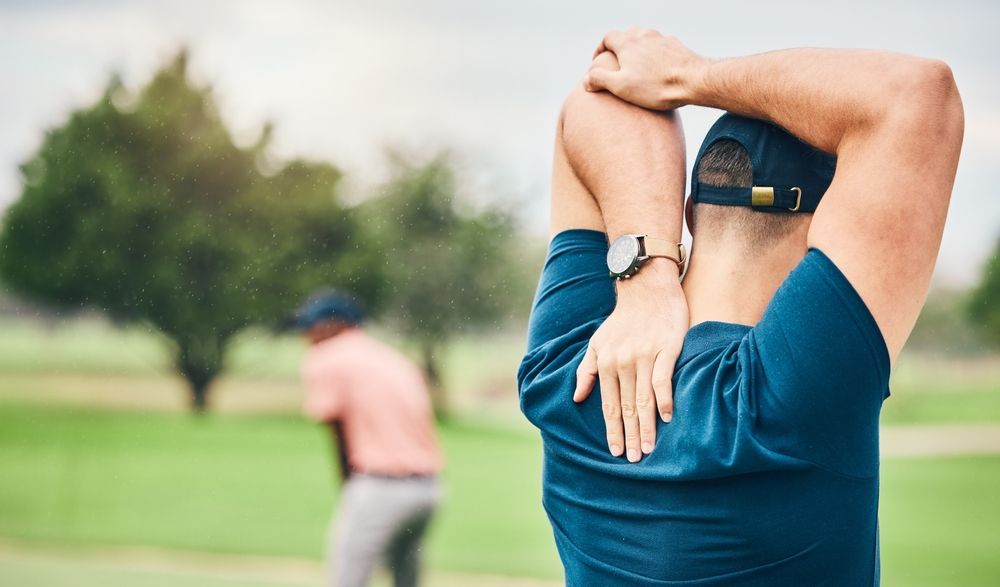
Simple Stretches for Improving Your Golf Game

Each exercise should be done for about 1 minute on both sides of your body to keep symmetry and be completed at a pace to get to your target heart rate. 


Neck Circles 

Drop your chin down to your chest, then rotate your head in a circle, bringing your ear to your right shoulder, continue rotating lifting your chin up to the sky, then bringing the ear to your left shoulder, and finishing back to the original position you started in. Repeat for 30 seconds and then switch directions. 


Neck Rotation 

Turn your head to the left and hold for 2 seconds, then to the right and hold for 2 seconds. Creating the motion of shaking your head “no”. Continue for 60 seconds. 


Torso Rotation with Club 

Stand in a 5-iron posture with your feet shoulder-width apart, and a slight bend in your knees and waist. Hold the club in front of your shoulders with crossed arms, and keeping your hips steady, rotate your shoulders from side to side. The end of the club should point forward at the biggest point of the stretch.


Side Bends with Club 

Stand with your feet shoulder width apart. Hold the club on your shoulders behind your neck. Keeping your back straight, bend to your left and hold for two seconds, then to the right and hold for two seconds. Make sure you’re not bending forward or backward as you bend from side to side. 

Shoulder Circles 

Do small shoulder circles for 30 seconds, lifting your shoulders to your ears then back down, first clockwise and then counter clockwise. 


Toy Soldiers 

Walk forward, kicking one leg and then the other out in front of you while keeping your back and knees straight. As you kick, reach your arm on the same side, aiming to touch your toes to your fingers. Keep your toes flexed toward your body as you kick. 


High Knee Walk 

Walk around where you are, and with each step, grab your leg just below the knee with both hands and pull it as close to your chest as possible, feeling a stretch in the glute. Hold the stretch for a second and then release and take the next step. 


Reverse Lunge Calf Stretch 

Stand with feet shoulder-width apart and step back with one leg. Keep your back knee straight with your heel on the ground as you bend your front knee and drop into a slight lunge. Hold for a moment and then switch legs, alternating legs for 60 seconds. Hold onto a wall or chair if you need to. 


You might wonder where the static stretching is in this warm up. Research has shown that static stretching (holding a stretch for a long period of time) done before activity can actually hurt your performance. However, static stretching is an important part of the cool down after activity.

Squats with Club

Hold the club overhead with both hands, keeping your arms straight. Slowly lower into a squat, ensuring your back stays straight and your heels remain on the ground. This stretch opens up your hips, strengthens your core, and enhances your upper body rotation, all of which contribute to a smoother, more powerful golf swing.


Shoulder Floss with Club

Grip the club with both hands, holding it wider than shoulder-width apart. Slowly raise the club over your head and then lower it behind you as far as comfortable, keeping your arms straight. 


So before you head out to play your 18 holes, remember to stretch and continuously re-hydrate with some water while you are out on the green!


If you are experiencing pain, do not ignore these warning signs as it can lead to chronic detrimental effects and a more serious injury if unchecked.


Seek out a licensed Physical Therapist at Rock Valley Physical Therapy before the injury develops and identify possible causes contributing to the pain. A Physical Therapist will develop a plan to get you back to their optimal playing performance. At Rock Valley Physical Therapy, we offer an injury screen to assess the injury and explain treatment options. Knowledge of common risk factors, impairments, and effective strategies/interventions can prevent or minimize the impact of these injuries.

Connect With Us:

More Tips, Insights & Recovery Advice

Man standing in front of Rock Valley Physical Therapy sign in a blue-walled office lobby.
By Kylie Williams June 10, 2026
“Max has been the best physical therapist I have had,’’ she said. “He sincerely listened to what I had to say and was knowledgeable when I asked him questions. He continually asked how the exercises and treatments were feeling. He knew the pain I was in because by surgery time, I could barely walk, sit, or sleep."
By ashley johnson June 4, 2026
We often think of physical therapy as something we only need after a sports injury or a surgery. While PTs are certainly experts in fixing knees and backs, their role in your health goes much deeper. In fact, one of the most important muscles a physical therapist can help you strengthen isn't in your leg or your arm, it’s your heart. Heart disease remains the leading cause of death globally. According to recent data from the American Heart Association, someone in the United States dies of heart disease every 34 seconds. The good news? A lot of cardiovascular disease is preventable through lifestyle changes, with regular movement being one of the most powerful medicines out there. The Challenge of Getting Started Current health guidelines recommend that ad ults get at least 150 minutes of moderate-intensity aerobic activity per week. H owever, for many, that goal feels out of reach. Maybe you want to start walking or cycling, but an old nagging injury flares up every time you try. Or it could be the fear of "doing too much" after a health scare that keeps you on the couch. This is where physical therapy becomes your heart's best friend! How a Physical Therapist Supports Your Heart A physical therapist is a movement specialist. They don't just look at a painful joint, they look at how your whole body moves and how your heart and lungs respond to that movement. Here is how they help you go from staying still to getting active: Before Activity: Before you start a new exercise routine, a PT can assess your balance, strength, and cardiovascular response. This makes sure you start at a level that is challenging enough to strengthen your heart but safe enough to avoid burnout or injury. Overcoming Pain: Many people stop exercising because of joint pain. A PT identifies the root cause of that pain, whether it’s a weakness in the hip causing knee pain or poor posture affecting your breathing, and provides a plan to fix it so you can keep your heart rate up without the aches. Recovery and Beyond: If you have experienced a major health event like a heart attack, stroke, or are undergoing cancer treatment, exercise is vital but can be intimidating. Research highlights that supervised exercise programs led by PTs significantly reduce fatigue and improve quality of life for people recovering from complex medical conditions. Managing Chronic Conditions: Physical therapy is increasingly used to help manage conditions that affect the heart indirectly, such as Type 2 diabetes and high blood pressure, by creating sustainable, low-impact movement plans. Movement is Medicine You don’t need to be a marathon runner to improve your heart health. Brisk walking, swimming, or even gardening can make a massive difference. The key is consistency and safety. If you’ve been hesitant to get moving, or if pain is standing in your way, consider a physical therapy evaluation. Your PT can help give your heart the support it needs to keep you moving for years to come.