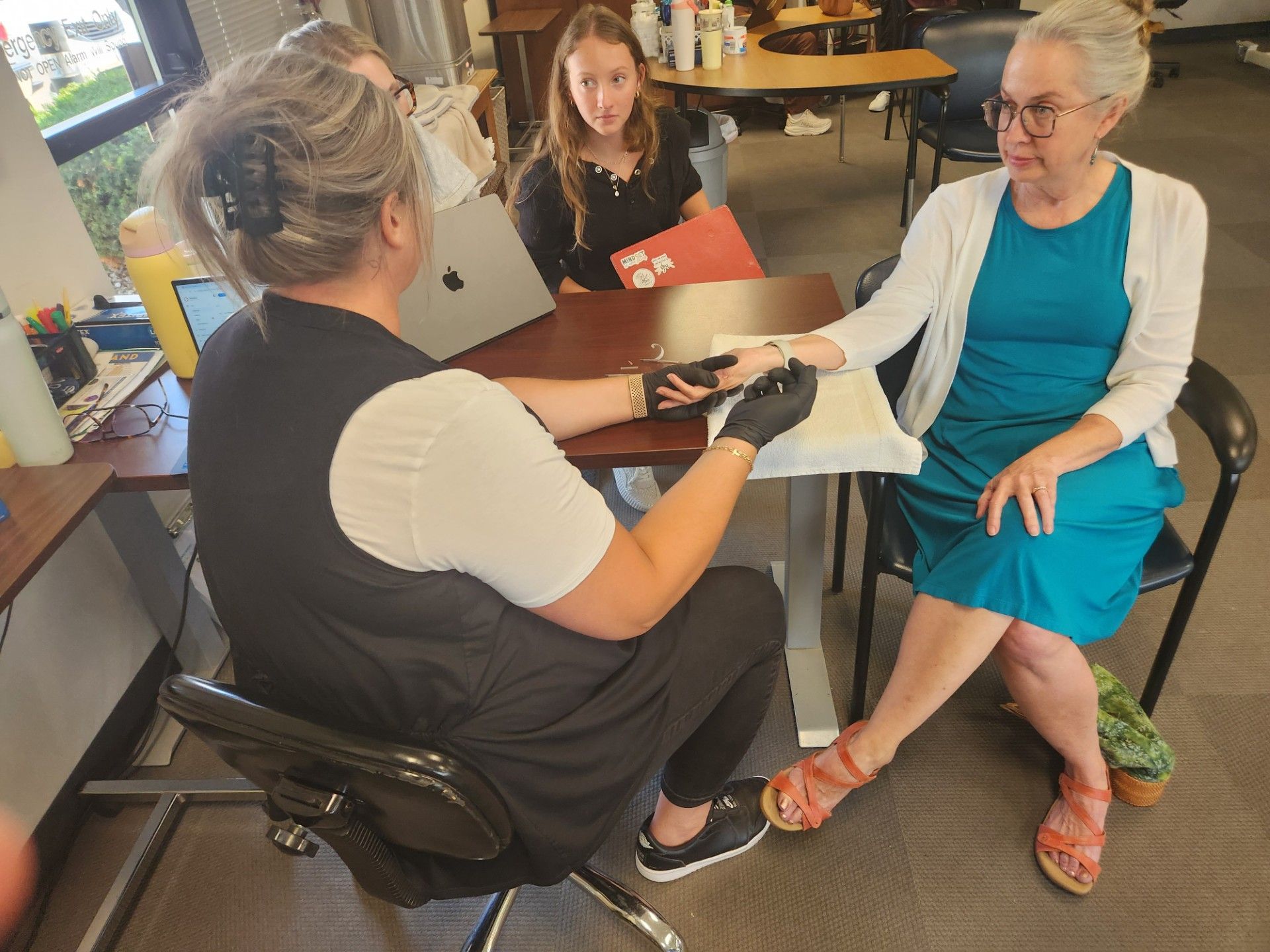
As soon as she sat, Karen Harper crossed her left leg over her right, took a deep breath, and smiled.
Just in case, Harper’s left – and potential kicking leg – was inches from the ever-so-gifted and beyond compassionate occupational therapist.
The one with seven needles at her disposal.
The path to uncurling the fingers on Harper’s surgically repaired right hand, was about to take an uneasy-during-the-process-but-amazing-when-completed – path.
“She hasn’t smacked me yet,’’ said Rock Valley Physical Therapy’s Calli Kahl, MOT, OTR/L, CMTPT/DN, an expert in the field of dry needling.
“YET…’’ Kahl added, evoking a huge laugh from Harper, who then showed Kahl just how close her left foot was to her and how easy it would be to reach her if Kahl induced enough pain.
Laughter followed. The day, it must be noted, was filled with smiles and a bevy of belly laughs.
Harper, a wonderful soul, and Kahl are far more than gifted OT and patient. They are trusted confidants. The “Calli and Karen Show’’ – for much of the next 40 minutes – was the highlight of Rock Valley Physical Therapy’s Muscatine, Iowa-based Cedarwood Clinic.
When they laughed – and they laughed often – those around them laughed.
The two – through Kahl’s expertise and Harper’s severe case of Dupuytren's contracture and numerous surgeries (six) – including amputation of her pinky finger on her right hand – have become close over the past several years. It is what happens when someone like Harper – stricken with an issue she did nothing to cause – turns to someone like Rock Valley’s Kahl to better her life in dealing with – if left untreated – a debilitating issue involving her hands.
Dupuytren’s contracture is a progressive hand condition where the connective tissue (fascia) beneath the palm and finger skin thickens and shortens. This tightening forms hard lumps and rope-like cords that eventually pull one or more fingers — most commonly the ring and pinky fingers—into a bent position toward the palm.
The condition typically progresses slowly, over months or years, moving through three main stages, the final being contracture. While the exact cause remains unknown, Dupuytren’s is hereditary and considered a genetic disorder, with a higher risk if you are of Northern European or Scandinavian descent, over the age of 50, and have a family history of the disease. Harper falls under every category.
Yet in the truest sense of their mission together, Harper, a longtime pharmacist in Muscatine, Iowa – with a tremendous grasp of the medical side of life – trusts a talented and compassionate OT like Kahl to make her life better.
A trust Kahl – who gained dry needling certification through the top-notch Myopain Seminars – has earned her amazing ability to maneuver small needles inserted into the skin.
“Miss Karen has a significant and rather severe issue with Dupuytren’s,’’ Kahl said. “You see it in specific areas (of the hand) especially the ring and pinky fingers, but Miss Karen is so blessed that she has it everywhere, including the thumb,’’ continued Kahl – who has become adept at all levels of dry needling – bringing laughter to those gathered.
Professionally, it is common for a physical therapist to have dry needling in their toolbelt, but not as common for an occupational therapist. Seeing it as an opportunity to add to her practice, Kahl – who has become so proficient in dry needling that it plays a huge role in her everyday practice – took on the challenge.
Many focus on trigger point (TrP) dry needling, but in Harper’s case Kahl uses dry needling for fascial adhesions, scar tissue, tendinopathies or enthesopathies.
Using a different sized needle – designed for fascial adhesions and scar tissue – Kahl works delicately and diligently to release the curled fingers on Harper’s right hand. Each needle is inserted into and around a healed scar, creating microscopic lesions that prompt the body to break down tangled, disorganized collagen fibers.
It is important to note that rotating the needle causes mechanical stress, but it restores the scar’s mobility and pliability. The process improves tissue flexibility, encourages healthy blood flow, and promotes the realignment of the tissue. The results, after several tense and sometimes painful moments of needle-insertion and rotation, are amazing.
“I wish I could have found Calli after the first one (surgery) in that I believe I might have avoided other surgeries,’’ said Harper, who carries an amazing – and optimistic outlook on life.
“She is that good. Her approach is amazing and we get along well. We laugh a lot. You must have a sense of humor because it can be uncomfortable when she inserts the needles.’’
Treating Harper on this day – using seven needles specifically designed for scar tissue and inserted and rotated into a scar-heavy portion of the hand – is not easy on patients and the OT. But Kahl and Harper have such a tremendous relationship they – even when Harper feels discomfort – work through all issues.
“Think of the nerve endings in the hand,’’ Kahl said, noting the sixth of the seven needles she will insert on this day caused Harper to nearly jump from her seat. “And that area is not a great place to have needles placed, but Miss Karen pushes through. She knows it is beneficial to what she deals with each day. I know there is discomfort at times and that bothers me greatly to see it with Miss Karen, but again we push forward because of the difference it makes. It also helps that Miss Karen is amazing, and it is important to do all that I can to better her life. She truly is amazing, and she is tough.’’
Harper, it cannot be emphasized enough, is tough as nails, knows the benefit of dry needling, and has an amazing sense of humor.
“We deal with the pain simply by making each other laugh,’’ Harper said. “We have a lot of laughs.’’
While working with Harper, Kahl also does an amazing job of sharing up-close information and guidance with two student clinicians, one an OT doctoral candidate from St. Ambrose University (Stephanie Gulasy); the other an OTA candidate (Katelyn Shelangoski) from Hawkeye Community College.
Kahl shares how – through the strategically-placed needles – each on a specific area to help Harper – can get her Harper’s middle finger as close to straight as is physically possible while suffering from Dupreyten’s.
“Calli is so good at this,’’ said Harper, who had a successful three-decade career as a pharmacist. “You wonder how/why I can deal with this (discomfort during the procedure) and it's rather simple, Calli is great at what she does. She talks me through things, and I know – and see – the benefit from all she is doing. I will trade some discomfort – and occasional partial jump from my seat – for the benefits of this.’’
By: Johnny Marx, Rock Valley Storyteller