


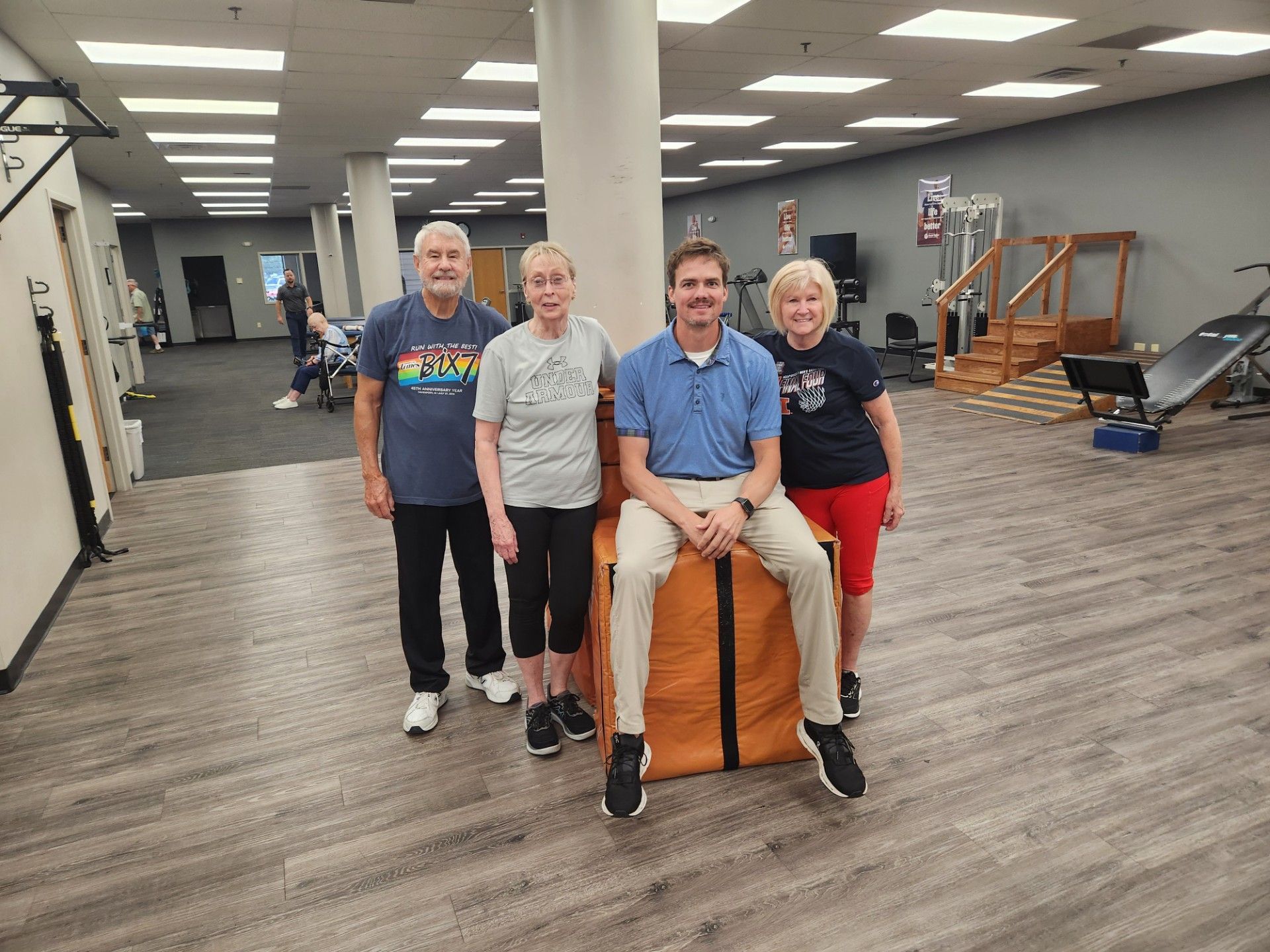
It is 9:59 and some change on a gorgeous Friday morning. The whirling dervish that is Barbara Hartman, half skips her way in the door and back to the area where – always punctual and forever-patient Crystal and Joe Arnold – are waiting for Rock Valley Physical Therapy’s 10 a.m. advanced fitness class (offered every Monday, Wednesday and Friday at 10) to begin. The Arnolds, like Hartman, are 24-karat gems. They, however, have been on site and stretching for 20 minutes. The group is one of three adult fitness classes – led by Performance Enhancement Specialist Cody Lichthardt, CSCS – Rock Valley Physical Therapy offers. On Tuesdays and Thursdays from 11-11:30 a.m. Lichthardt’s beginner class features a chair-based workout of low-intensity exercises centered around movement. With a dozen-plus members it is the largest of the three groups that Lichthardt – who has a bevy of personal training clients as well – teaches. The intermediate group meets at 11:15 every Monday, Wednesday, and Friday. It exercises for approximately 45 minutes. The group is self-paced, with low-impact and low-intensity guided exercises. The class is designed to stay with one specific workout for a given time. Armed with a doctorate in kindness and patience – Lichthardt begins – without Hartman – to write the day’s exercise plan on the white board. The fitness area is in the southwest corner of Rock Valley’s Avenue of the Cities (3800 Ave. of the Cities, Suite 107, (309) 743-0106 for pricing or Cody.lichthardt@rockvalleypt.com ) location. Occasionally, much to the amusement of those gathered, Lichthardt must pause his writing so that the kind-hearted Hartman, whose daughter was a cheerleader for the Fighting Illini, can comment on the merit of each exercise on the board and give Lichthardt her latest scouting report on all Illinois’ football and basketball, respectively. In mid report, Hartman is stunned to learn Bill Self, the former Illinois basketball coach who leads the Kansas Jayhawks these days, might not sport his own hair atop his head. The beginning of the advanced class, it must be noted, is oftentimes humorous theater. The advanced fitness class Lichthardt leads is one hour in length, and its primary goal is to enhance strength, a vital component to the overall fitness and well-being of the older adult. It is, thanks to those in attendance and being challenged physically each time out, fun. Like every fitness class Rock Valley offers, there are challenges. The rewards, however, far outweigh any challenge. “Maintaining one’s strength is important for independence and overall health,’’ Lichthardt said. “We work on movement patterns and functional fitness. Each day is different, covering the entire body. Most of the time is its functional fitness using body weight, free weights, bands, and cable machines.’’ Lichthardt’s advanced group has been with him the longest, all 10-plus years of his service with Rock Valley. There are 8-to-10 members of the lot, with a core of six regulars. All are friends and important pieces in each other’s lives – the advanced group – like his other two classes – have a soft spot in Lichthardt’s heart. Hartman, her husband, Dave, Crystal and Joe Arnold, Sue Just, Franz and Mary Bender, are the longest-tenured members of the class and are some of the finest people on the planet. They have picked up from where Mel Block, Dave Hartman and the late Don Turner began with Holly Blaser (MA/ Exercise Physiology) over a dozen years ago. “One of the main benefits of getting to lead these classes is the family atmosphere and that we all communicate with each other outside of here (Rock Valley),’’ Lichthardt said, noting the entire advanced class recently shared Crystal Arnold’s 75th birthday celebration, that they recognize birthdays and try to spend time together during the holidays. “And you learn about each other’s family – all the groups. I spend more time with these people than I do with some of my extended family. I see them more than some of my aunts and uncles.’’ From time to time, Crystal Arnold, an amazing and compassionate sort with a heart of gold, must deal with a balky back. She says the combination of therapy and then exercise, has been huge to her overall well-being. Danny Fleener (Clinic Manager (Ave. Of the Cities), PT, MPT, OCS, CMPT), has played a huge role in bettering Crystal Arnold’s life and working through her back issues. Fleener, Arnold says, recognizes the importance of an exercise-based lifestyle. “Danny says if I didn’t have this class I would be struggling mightily with my back,’’ Arnold said. “I trust his expertise. He says my back would be that hinge on that old door that is creaky if I didn’t have this. And he is right. This gives Joe and I a chance to keep busy, be challenged physically, and be around people we care about.’’ Lichthardt says having an amazing group of Rock Valley therapists – across the board – has been the No. 1 source of exercise-class referrals. “Their great work and sharing that we offer fitness programs, has been amazing,’’ Lichthardt said. “It’s a lot of word of mouth, but it starts with the fantastic job the therapists do and the patient seeing just how wonderful the people of Rock Valley are. For me this is something I love to do, want to do for the rest of my life, and hope I get to do that long. The people in these classes are amazing, as are my personal training clients. It is important to never stop moving.’’ By: Johnny Marx, Rock Valley Storyteller

Protect your back and joints while decorating for the holidays with safe lifting, stretching, posture, and ladder tips from Rock Valley PT.