
Certified Athletic Trainers from Rock Valley Physical Therapy at the forefront of student-athlete safety, concussion protocols for high school football
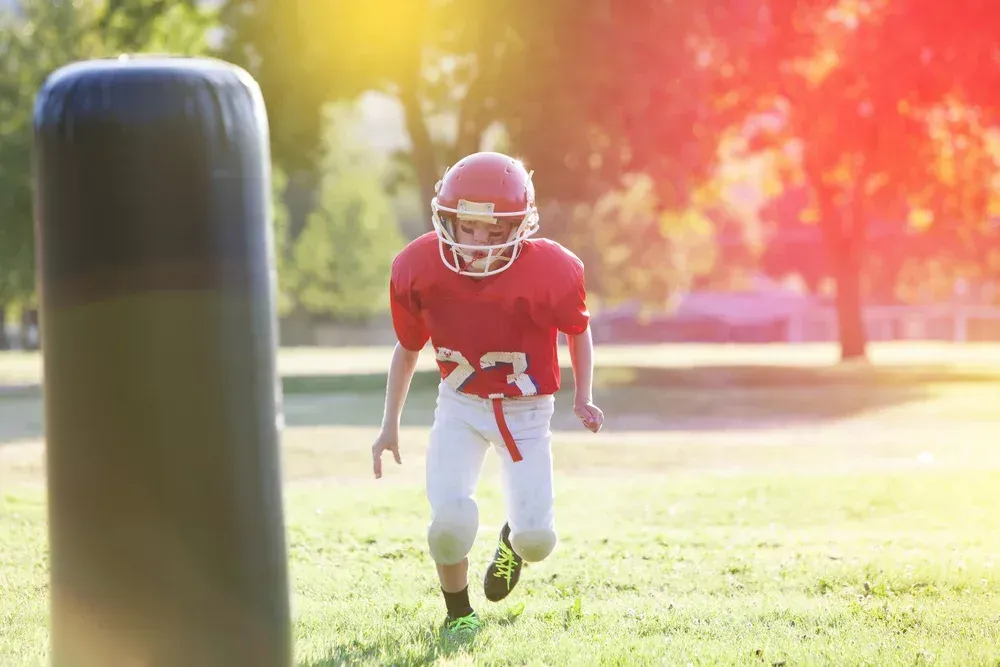
Are you ready for some football?
From the National Football League, across the college landscape – and high school football in Illinois, Iowa, Nebraska and South Dakota, the four states Rock Valley Physical Therapy provides athletic training services to high schools, respectively – America’s No. 1 sport is upon us.
The safety and well-being of those playing – and those hoping to play the game – is vital to football’s future. Despite advancements in equipment and rule changes designed to better serve the player, injuries – concussions – remain a big part of football’s landscape. Steps taken to prevent and treat concussions are better than ever. Growth in testing and post-concussion care have – in a positive fashion – traveled light years from days past.
Certified Athletic Trainers from Rock Valley Physical Therapy are vital members of any high school they serve and play a significant role in providing exceptional concussion-related care for the athletes in their charge.
That kind of expertise and care will never change.
WHAT IT IS:
A sport-related concussion is a traumatic brain injury caused by a blow to the head, neck or body that causes the brain to move rapidly inside the skull. Symptoms can appear immediately or develop over the next several hours. One does not have to lose consciousness to have a concussion.
An estimated 100,000-to-150,000 concussions occur annually in high school football across the United States, meaning 10 percent of all high school football players suffer a concussion each season. Researchers, however, note that up to 50 percent of these injuries go unreported.
In the past decade, tracking from entities like the American Academy of Pediatrics and the National Federation of State High School Associations, highlight a distinct shift in how and when these head injuries occur.
Those findings showed:
- Game-related concussion rates have taken an upward trajectory, sitting at 10.4 to 11.2 concussions per 10,000 athletic exposures. This is driven by increased medical awareness, stricter reporting laws, and better detection by athletic trainers.
- Practice rates have dropped: Concussions during practices have steadily declined. This drop is widely credited to state laws limiting full-contact practice hours and the adoption of safer tackling frameworks like USA Football’s “Heads up Football.’’
Common concussion symptoms may include:
- Headache.
- Motion sickness.
- Dizziness.
- Nausea.
- Balance problems.
- Sensitivity to light.
- Confusion or difficulty concentrating.
Emergency warning signs such as repeated vomiting, seizures, slurred speech, or worsening symptoms require immediate medical attention.
SAFETY BEFORE YOU START/A PRESEASON TEST:
All Rock Valley Physical Therapy athletic trainers receive specific instruction in baseline testing and concussion management, providing vital information in concussion education to athletes, parents/guardians, coaches, school administrators, and school staff.
The process to ensure safety, provide immediate and great care in case an injury occurs, are benchmarks of Rock Valley Physical Therapy and its team of dedicated, knowledgeable, and compassionate athletic trainers.
It is vital to note that schools with athletic trainers are at least four times more likely to recognize and diagnose concussions than schools without them.
“You want to be that first line of defense,’’ said Rock Valley Physical Therapy’s Blake Anderson, LAT, ATC, who serves as the athletic trainer at Rockridge High School (Taylor Ridge, Il.) “This is just a part of what we are entrusted with, but it is a big part. I know for us (Rockridge), we like to get a jump on things, and I like to email the coaches in charge of the fall athletes early in the summer. We go to a contact (football) camp at Monmouth (Il.) College in July. Because those are contact days allowed by the IHSA, we like to have baseline testing done before we make that trip.’’
The hope of the Rock Valley athletic trainer is to ensure that each football player undergoes baseline testing using SWAY, an app-based testing tool. A baseline concussion test is a computerized assessment of brain function while healthy. SWAY uses one’s smartphone's built-in sensors to measure balance, postural stability, and cognitive function before an injury occurs.
SWAY testing occurs on a bi-annual basis (usually freshman and junior seasons or first-time players out for football). It is also used as a post-concussion evaluation tool, usually done between 24-to-72 hours after the injury occurs. Those scores will be compared to the student athletes’ baseline test to measure cognitive deficits, track recovery, and safely guide a student athlete’s return to play.
A typical baseline assessment covers several key areas of cognitive function and physical capability.
It measures:
- Memory: Word recall and visual memory.
- Processing speed and reaction time: How fast and accurately your brain responds to stimuli.
- Attention span: Ability to focus on tasks and avoid distractions.
- Balance cognition and function.
- Physical assessment of sensory organization.
“With this program we can do all the kids at once,’’ Anderson said. "When monitoring their progress, we can use our laptop or phone to see which test they're working on and how they are doing. If any questions arise, we are there to answer them and steer them in the right direction.’’
Once practice (players and coaches have begun pre-season practice for the 2026 season) and games begin, every Rock Valley Physical Therapy athlete trainer follows a strict plan regarding any head injury.
Though similar in approach to treating a player with a head injury, the settings – practice and games – are different for the Rock Valley athletic trainer.
At practice, the player is removed from anything that would distract and taken to a quiet area for an evaluation and testing, usually the athletic training room. The athlete’s parents/guardians are notified, coaches are informed, and members of each school’s concussion care team are notified.
In Iowa, state law requires that if anyone is removed from an athletic event because of a head injury, they must be evaluated by a licensed healthcare provider, which includes athletic trainers. The student is removed from anything that would distract and taken to a quiet area for an evaluation and testing, usually the athletic training room. The athlete’s parents/guardians are notified, coaches are informed, and members of each school’s concussion care team are notified.
“If I’m taking someone out of practice because I am concerned that they have a concussion, I must do an evaluation,’’ said Rock Valley’s Jessica Rummery, MS, LAT, ATC, an athletic trainer at Bettendorf (Iowa) High School, “So that’s what I am going to do and do it full tilt. And when it comes to parents, I like to see them, chat with them face-to-face, show them the (SWAY) data,’’ Rummery added, noting the SWAY software has a full examination – an assessment – that takes about 10-to-15 minutes and will relay a percentage of function loss. Anything larger than a 10 percent change and she – like all Rock Valley athletic trainers – will take a deeper look into the issue at hand.’’
GAME NIGHT PROTOCOL:
If during a game a player suffers what is believed to be a concussion, the Rock Valley athletic trainer– in tending to the player – makes sure the head official (referee/white hat) has the correct number of the affected player being removed from the contest.
The injured player’s parents/ guardians – if in attendance – are notified immediately. If not attending the game, the player’s parents/guardians are called and informed of the situation. Though the game procedure closely follows the practice plan of assisting a player for evaluation, there is an accompanying crowd of people for all to navigate.
The Rock Valley athletic trainer then begins the examination using the SWAY app to determine the extent of the injury. Anderson and Rummery say they are beyond blessed to have extra sets of eyes just to confirm their diagnosis.
“In my case, I am fortunate to have two amazing doctors on the sidelines with me, and I will ask them to take a look just to confirm everything for me,’’ Rummery said of her Bettendorf High School sideline. “Not everyone is that fortunate.’’
At all Rockridge games, Anderson says he has the benefit of an emergency room physician with him on the sidelines.
“It’s comforting to have someone with their background on hand,’’ Anderson said. “It is a benefit for us all, and we (ATs) appreciate the fact doctors have grown to trust us and Rock Valley when it comes to this. Also, in most places, there is an ambulance service with EMS available. I cannot imagine not having something available for athletes.’’
The injured student athlete is then monitored for the rest of the game/day of the event at frequent intervals for deterioration of symptoms or red flags. The athlete will be taken for appropriate medical attention if they show any red-flag symptoms or signs of deterioration.
NEXT STEP:
As part of an initial evaluation, the student athlete – under the watchful eye of the Rock Valley athletic trainer – will complete a post-injury SWAY test within 24-to-72 hours after the injury occurs. The scores will be compared to the student-athlete’s baseline test. If there was no baseline test completed the scores will be compared to normative data for persons in the same age group and sex of the student-athlete in question.
The Rock Valley athletic trainer or team physician will interpret the SWAY scores, though SWAY testing is not the sole determining factor for concussion diagnosis and management. The Rock Valley athletic trainer will perform additional evaluations and SWAY testing to initiate, and progress through, the concussion protocol.
It is recommended that screen time (TV, phone, and computer) be limited for the first 48 hours, that Acetaminophen be used instead of NSAIDs, and that the athlete not drive until they are re-evaluated. It is not necessary to wake the student athlete from sleep to check on them periodically.
RETURN TO LEARN:
The Rock Valley athletic trainer will notify the school-based concussion team of the injured student and recommendations of Return to Learn (RTL) and Return to Sport (RTS).
It then begins a four-step Return to Learn (RTL) protocol:
- The goal of Step 1 is to return to typical activities and possible school activities.
- The goal of Steps 2-3-4 is increased tolerance to cognitive work, including academic re-entry, moving incrementally from daily activities with minimal screen time to homework, part-time school, and finally full-time school, catching up on missed work.
- Note: If a student struggles with each step of the cognitive return, he repeats the day/task or scales back the activity.
- The school-based support team is notified to help manage temporary academic adjustments like extra time, rest breaks, or formal 504/IEP plans. This varies from school to school.
- The injured student must complete a full return to school before they can be cleared to fully return to sports.
“It’s vital these hurdles are cleared before you begin any return to sports protocol,’’ said Anderson, who is in his sixth year at Rockridge, eighth overall as an AT. Rummery is in her 11th year at Bettendorf. Both are gifted, knowledgeable and compassionate athletic trainers.
“You adjust the best you can,’’ Anderson said. “Does the student athlete need to wear sunglasses? Do they need something printed which is easier to read than looking at a screen? You send that note to the school nurse who can inform his teachers. We are so lucky that school nurses are great, and the school staff understands the process. They simply want what is best for the student.’’
RETURN TO SPORT:
Returning to the field of play involves a six-step progression for the injured student athlete:
- Physical re-entry moves sequentially from light daily activity to aerobic exercise, individual drills, non-contact training, full-contact practice, and game play. Each step requires a minimum of 24 hours before advancing to the next.
- Exertion clearance: Athletes must be completely symptom-free at rest and after exertion before advancing to non-contact and full-contact drills (Steps 4–6).
- Handling symptoms: If symptoms flare during Steps 1–3, pause exercise until the next day; if they flare during Steps 4–6, drop back to Step 3 until fully resolved.
- Written release: Unrestricted clearance to return to play requires formal written authorization from a qualified healthcare provider.
Here are examples of daily living activities to be monitored:
- Home activities such as social interactions and light walking that do not result in more than mild and brief exacerbation (worsening) of concussion symptoms.
- Continue to minimize screen time.
- Aerobic exercise: Light effort (up to approximately 55 percent of maximum heart rate)
- Moderate effort (up to approximately 70 percent of maximum heart rate).
- Start with stationary cycling or walking at a slow to medium pace. Take a break and modify activities as needed with the aim of gradually increasing tolerance and the intensity of aerobic activities. Light resistance training that does not result in more than mild and brief exacerbation (worsening) of concussion symptoms. The goal here is to increase the heart rate.
- Gradually initiate sport-specific activities away from the team that do not have a risk of inadvertent head impact, including running, change of direction, and/or individual training drills and individual gym class activities that do not have a risk of head impact and are supervised by a teacher or coach.
- Increase the intensity of aerobic activities and introduce low-risk sport-specific movements and changing directions. Medical clearance and a full return to school are required to progress.
- Non-contact training drills and activities Exercise to high intensity including more challenging training drills and activities (passing drills, multi-player training, high-intensity exercises, supervised non-contact gym class activities, and practices without body contact).
- Resume the usual intensity of exercise, coordination, and activity-related cognitive skills.
“At the end of the day, the health and safety of our athletes is our greatest concern,’’ said Anderson. “As athletic trainers, we play a vital role not only in concussion management and treatment, but in the overall well-being of our athletes. Concussions will unfortunately continue to be a major obstacle in all secondary school (high school) and youth sports—especially in a high-contact sport like football. However, with the dedicated care and work that athletic trainers and many other medical professionals continue to pour into concussion management, our hope is that advanced treatment and growing awareness will give athletes and parents peace of mind and better outcomes when injuries occur. We want them to know they are in good hands and that we will do everything possible to provide the best preventive and post-injury care."
By: Johnny Marx, Rock Valley Storyteller
More Tips, Insights & Recovery Advice